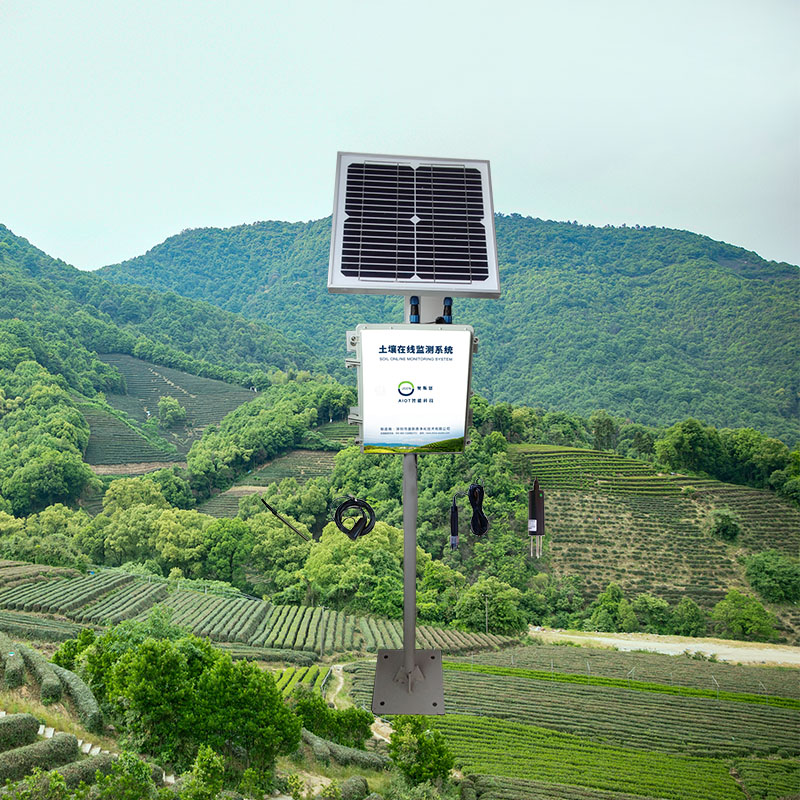
OSEN farmland soil monitoring station precise and traceable data scientific guidance for planting
2026-02-26 17:04:10
Soil, as the foundation of agricultural production and the core of terrestrial ecosystems, has a direct impact on food security, the quality of agricultural products, and ecological environmental safety. However, long-term unreasonable farming practices, excessive use of fertilizers and pesticides, and industrial pollution emissions have led to increasingly prominent issues such as soil compaction, fertility decline, heavy metal pollution, and salinization, posing serious threats to sustainable agricultural development and public health. Traditional soil monitoring mainly relies on manual sampling and laboratory analysis, which has systematic shortcomings such as long monitoring cycles, poor data timeliness, insufficient spatial coverage, and inability to grasp dynamic changes, making it difficult to meet the urgent needs of precision management in modern agriculture and soil environmental protection.
The soil quality monitoring system enables round-the-clock uninterrupted monitoring. The system comprehensively, scientifically, and accurately reflects the changes in soil moisture content in the monitored area. The on-site remote monitoring equipment automatically collects real-time data on soil moisture content and utilizes GPRS wireless network for remote data transmission. The monitoring center automatically receives and stores the monitoring data from each monitoring point in the database. It can provide timely and accurate information on the soil moisture content at each monitoring point, providing important basic information for disaster mitigation, drought resistance, fertilization, and irrigation.
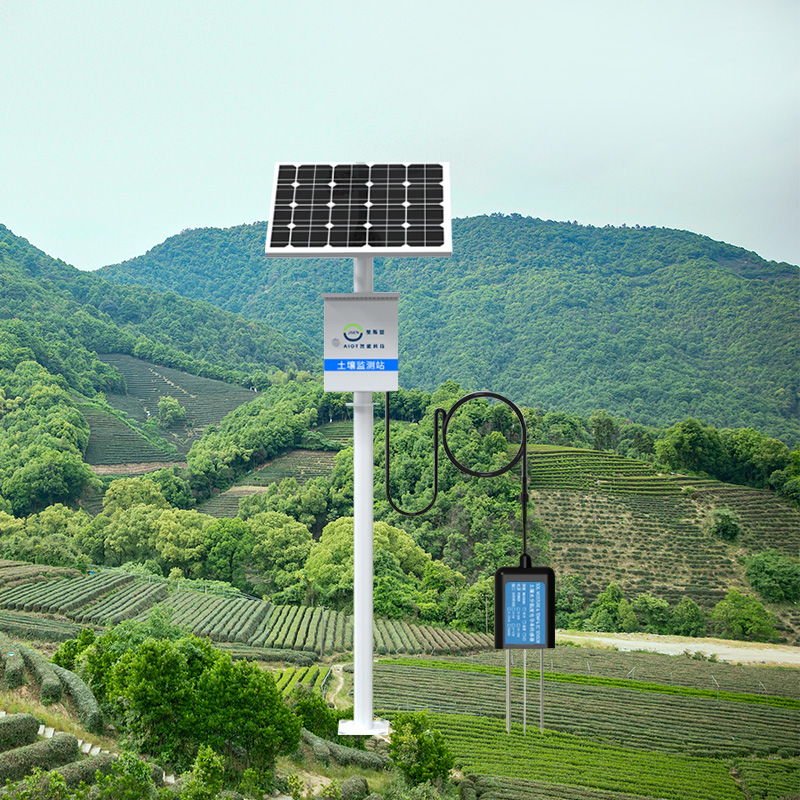
System functions
1. Real-time monitoring of soil temperature and humidity, with the flexibility to conduct single-channel measurements or multi-channel profile measurements at various monitoring points. This provides crucial basic information for fertilization and irrigation.
When the soil moisture exceeds the preset limit, alarm information can be reported to the user via GPRS, providing farmland environmental information for remote fertilization control.
3. Expand monitoring functions for soil salinity, nitrogen, phosphorus, potassium, pH value, negative oxygen ion concentration, particulate matter, temperature and humidity, CO2 concentration, etc.
4. The frequency of data collection and storage can be flexibly adjusted, and the operating parameters of monitoring equipment can be remotely set.
5. Remote monitoring equipment only supplies power to sensors during data collection, which not only conserves energy but also avoids measurement errors caused by changes in soil physical properties due to long-term power supply.
6. Supports multiple communication methods such as GPRS, SMS, and LAN, with GPRS wireless communication being recommended.
7. It can simultaneously report monitoring data to multiple centers.
8. It possesses the function of statistics and analysis for monitoring data and alarm data, and the data report can be exported and printed out.
9. The monitoring system software possesses GIS functionality, enabling the display of detailed distribution locations of various monitoring points on a map.
10. It is used for all-weather on-site monitoring of soil temperature, soil humidity, soil pH, and other factors. It can be connected to a computer through a professional supporting data acquisition communication cable, transmitting data to the soil computer´s soil database for statistical analysis and processing.
11. The soil moisture data logger is equipped with functions such as soil moisture data collection, scheduled storage of soil moisture data, parameter setting, a user-friendly software interface, and standard communication capabilities. It features graphical data display and wired communication methods, and can operate in a system environment of Windows 2000 or above. The stored data is in the standard EXCEL format, and it can generate meteorological data charts for use by other software.
12. LED wireless information publishing platform: professional and simple operation, convenient management, stable transmission, high reliability; capable of transmitting text and other program information, without distance limitation, widely applicable; after the terminal goes offline and comes back online, it can resume transmission, saving data traffic
13. Wired transmission method: Through a standard USB/RS485 communication interface, it is wiredly connected to the monitoring center PC for real-time transmission of collected data.
14. Wireless transmission method: As long as there is internet access, data can be viewed and analyzed through web browsing via GPRS wireless transmission.
Keyword: